To get rid of cooking smells, ventilate while you cook and for at least 15 minutes afterward, then treat the surfaces, because most lingering odor sits on counters, curtains and couches as oil residue. Wipe hard surfaces, spray fabrics with a neutralizer, keep charcoal bags out for background odor and replace a recirculating hood's carbon filter every few months.
Opening a window on its own often fails because most of the lingering smell isn't in the air anymore. It's on your countertops, curtains and couch, slowly releasing odor compounds for hours. That's the part most cooking-smell advice misses. If you're dealing with fish specifically, that's the hardest cooking smell to shift and we've written a separate guide for it. If the smell keeps coming back even after you ventilate, we explain the actual reasons here.
Why cooking smells linger
When you cook, oils and fats don't stay in the pan. Some of them turn into tiny airborne droplets. Frying is the worst for this, because hot oil throws droplets in every direction. Some go up into the range hood. Plenty don't, and they land on whatever is nearby.
Cooking is also one of the biggest sources of fine particles (PM2.5) inside a home (the EPA lists it first, ahead of candles and fireplaces), and those levels stay up for a while after the burner goes off. That's why running the hood after cooking matters, not just during.
Some foods are worse than others. Fish gives off trimethylamine, which clings to fabrics. Curry spices contain oil-soluble compounds that stick to surfaces. Garlic and onion release sulfur compounds. Frying puts more into the air than boiling or baking, and deep-frying more than pan-frying.
This tells you the fix isn't just "get more air in." You have to deal with what has already landed, and stop as much as possible from landing in the first place.
Fix the source: ventilation first
Open windows on opposite sides of the room or the house. One open window lets some air in but doesn't create much movement. Two windows on different walls give you a cross-breeze that actually pushes the smelly air out.
If you can only open one window, put a box fan in it facing outward. It pushes stale air out and pulls fresh air in from elsewhere in the house. Not elegant, but it works.
Do this while you cook, not just after. Keep it going for at least 15 minutes once you're done, ideally 20. A 2018 Health Canada and Berkeley Lab study found that running the exhaust fan for 15 minutes after cooking lowered fine-particle exposure, even with a weaker fan. Most people close everything up too soon.
If your range hood vents outside, use it every time and turn it on before you start. If it's a recirculating hood (no duct to the outside), the Home Ventilating Institute points out it provides no real ventilation. It relies entirely on its carbon filter for odor, which brings us to the fix most people miss further down.
If cooking smells are traveling to other rooms or upstairs, that's a separate problem with its own fixes. We cover how to stop cooking smells spreading through the house here.
Passive absorbers: charcoal bags and how to use them
Activated charcoal (usually bamboo charcoal in consumer products) is full of microscopic pores that trap odor molecules by adsorption. It's a physical process. Nothing is added to the air and nothing is sprayed.
The trade-off is speed. Charcoal bags work over hours, not minutes. They won't save you right after a curry. But for ongoing background odor in a kitchen that gets used every day, they're cheap to run. Moso Natural says one bag lasts two years if you put it in sunlight for an hour once a month.
Put them near the stove, on top of the kitchen cabinets where warm air collects, and in rooms next to the kitchen where smells drift. Moso rates each 200g bag for up to 90 square feet, so for several spots the Moso Natural 4-pack makes more sense than a single bag.
If you're not sure whether charcoal bags, sprays or plug-ins suit you, we compare all three types and explain when to use each one.
Quick fixes: sprays, gels, and odor neutralizers
This is where most people start, and where the biggest misconception lives. Masking a smell and neutralizing it are different things.
Masking means adding a stronger fragrance on top. Standard air fresheners, scented candles and most plug-ins do this. The cooking smell is still there; you just can't pick it out under the lavender. When the fragrance fades, the cooking smell comes back.
Neutralizing means trapping or changing the odor-causing molecules so they don't reach your nose. Activated charcoal, enzymatic cleaners and neutralizing sprays work this way.
Right after cooking, a spray on the surfaces is the fastest fix. Hit the stovetop, countertops, backsplash and any fabric near the stove. We recommend Zero Odor, which the company says bonds with odor molecules and converts them rather than covering them with perfume. It's labeled for fabrics and upholstery too.
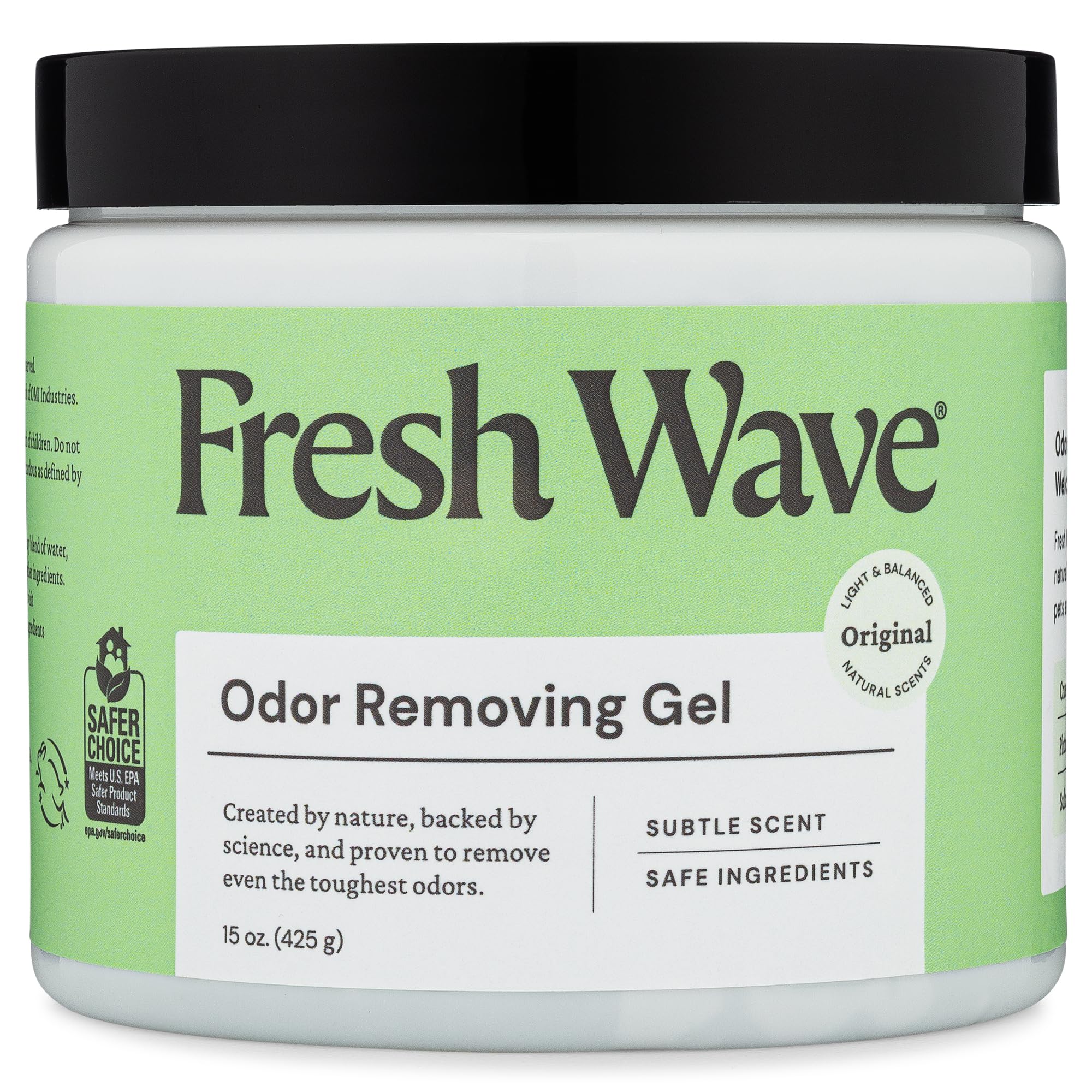
For the slow, all-day part, a jar of Fresh Wave gel on the counter is an easy addition. It's a plant-oil gel that Fresh Wave says absorbs cooking odors for 30 to 60 days. It's not an emergency fix, more a step up from charcoal for a busy kitchen.
For full product recommendations, see our buying guide for the best kitchen odor eliminators.
The forgotten fix: your range hood filter
This is the one most people miss. A recirculating range hood, one that doesn't duct air outside, pulls kitchen air through a carbon filter to strip out odors and then blows it back into the room. That filter wears out. Your hood's manual will give a replacement interval; every few months with regular cooking is typical.
Plenty of people have never replaced theirs. Some don't know there's a carbon filter in there at all (it usually sits behind the metal grease filters). A saturated carbon filter does next to nothing. The hood makes noise and air moves, but the odor goes straight through.
Quick test: turn the hood on and hold a tissue near the grille. If the suction is weak or the tissue barely moves, the grease filter is clogged, the carbon is spent, or both. Wash the metal grease filters in hot soapy water and replace the carbon.
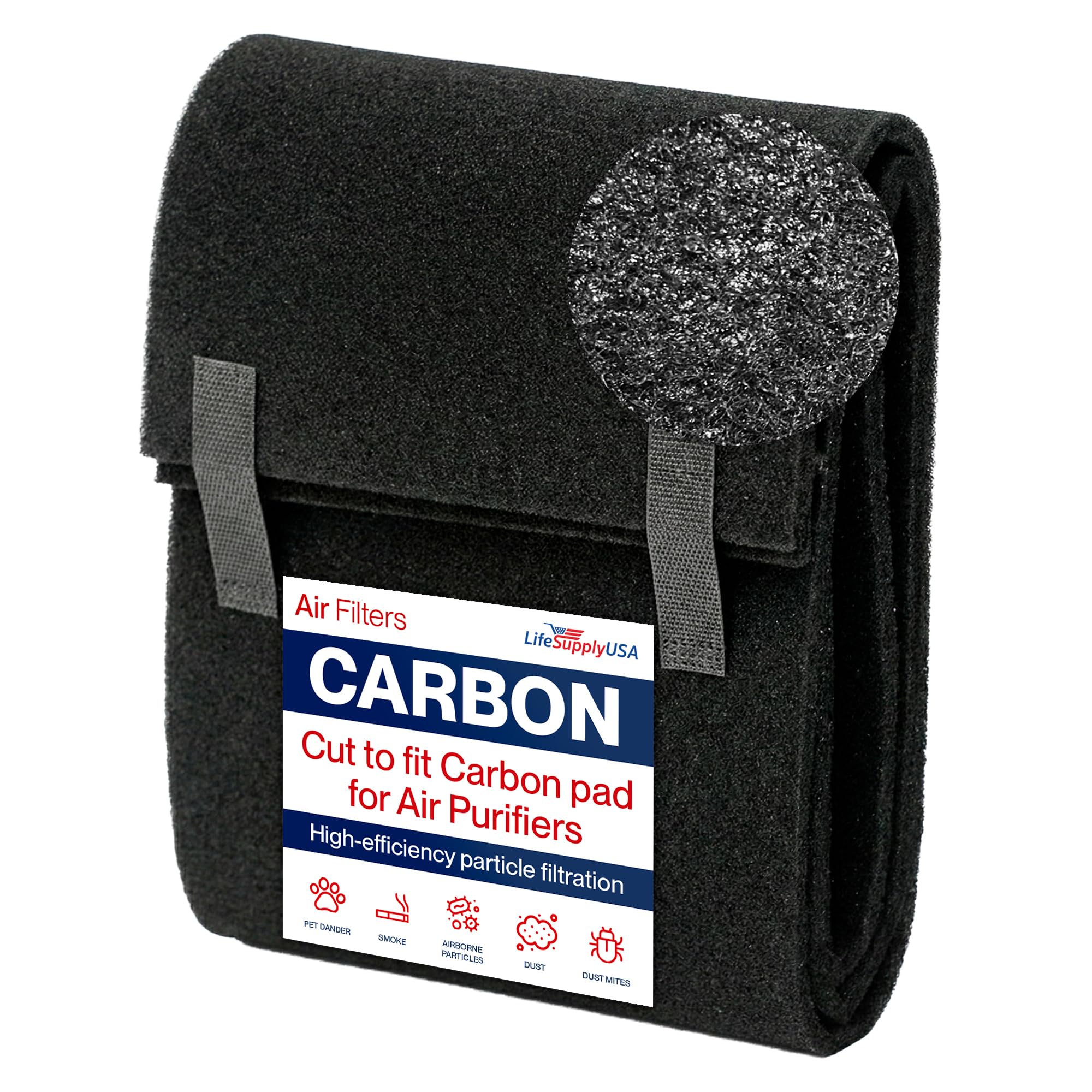
If your hood takes a flat carbon pad, a cut-to-fit activated carbon sheet is a cheap fix. The LifeSupplyUSA sheet is 16 x 48 inches for about $18, enough to cut several pads, and the maker suggests replacing it every six months depending on use. If your hood uses a sealed cartridge, buy the cartridge your manual specifies instead.
Full troubleshooting guide for range hoods that aren't clearing cooking smells.
Prevention: habits that stop smells building up
Dealing with cooking smells after the fact is fine. Stopping them forming is better.
Cook with lids on. Obvious, underused. A lid traps steam and oil droplets, so less ends up on your surfaces.
Use a splatter screen for frying. A mesh screen sits over the pan, lets steam out and catches a lot of the oil droplets. Much of the smell that ends up on your curtains got there as airborne oil during frying. A basic stainless screen costs around $10.
Turn the range hood on before you start. It needs to be pulling air before the steam rises. Leave it running at least 15 minutes after you finish.
Wipe down hard surfaces right after cooking. Don't leave it until after you've eaten. The residue starts settling in within minutes.
Wash dish towels and oven mitts often. They hang right next to the stove and soak up cooking smells all day. People wash their clothes and forget the dish towels.
When it's not cooking: when to suspect drains or appliances
Sometimes the smell isn't from last night's dinner at all. If the kitchen smells even when you haven't cooked recently, check:
- The drain. Food residue in the P-trap or garbage disposal rots and can smell like old cooking. Run hot water and dish soap through it. If that doesn't help, the trap may need cleaning out.
- The trash can. Especially in warm weather. Meat trays and fish wrappers start to smell within hours.
- The fridge or freezer. A spill on a back shelf you've missed. Raw meat juice is particularly bad.
- The dishwasher. Food trapped in the filter or door seal goes rancid. Pull out the bottom filter and clean it.
- Old cooking oil. Frying oil you reuse goes rancid after a few uses and smells fishy or stale even when cold.
If nothing in this guide helps and the smell has hung around for weeks, it could be plumbing (a dried-out trap letting sewer gas in) or moisture somewhere. Those need a different approach.
How to get rid of cooking smells: frequently asked questions
Why does my kitchen still smell after cooking even with the windows open?
Most of the lingering smell isn't airborne anymore. It has landed on surfaces and fabrics as tiny oil droplets, and those deposits keep releasing odor for hours. Opening a window clears the air but does nothing for what's already on your countertops, curtains and couch. You need to treat the surfaces as well as ventilate.
Do candles and air fresheners get rid of cooking smells?
No. They cover the smell with a stronger fragrance but don't remove the compounds causing it. Once the candle goes out or the spray fades, the cooking smell comes back. For real removal you need something that adsorbs or neutralizes the odor, like activated charcoal or an odor-neutralizing spray on the surfaces.
How often should I replace my range hood carbon filter?
Follow your hood's manual first. As a rough guide, every few months if you cook daily and up to about six months with lighter use. Plenty of people never replace them, which is why a recirculating range hood seems to stop working over time. A saturated carbon filter moves air but removes almost no odor. You can't wash the carbon back to life, so replace it when it's spent.
Should I leave the range hood on after cooking?
Yes, for at least 15 minutes after you finish. Cooking particles and odors don't vanish when the burner goes off, and a 2018 Health Canada study found that keeping the hood running after cooking cut the particles people were exposed to. Switching it off the moment the food is done is a common mistake.
Sources
- Dobbin NA, Sun L, Wallace L, et al. "The benefit of kitchen exhaust fan use after cooking: an experimental assessment." Building and Environment, 2018. Free PDF from Lawrence Berkeley National Laboratory.
- EPA. "Indoor Particulate Matter." US Environmental Protection Agency.
- EPA. "Volatile Organic Compounds' Impact on Indoor Air Quality." US Environmental Protection Agency.
- Home Ventilating Institute. "Ventilating living areas."
- National Library of Medicine. PubChem: Trimethylamine.
- Moso Natural. Amazon product listing for the Moso Natural Air Purifying Bag 200g. 2026.
- LifeSupplyUSA. Amazon product listing for the cut-to-fit activated carbon filter sheet 16x48". 2026.