A True HEPA filter captures at least 99.97% of particles at 0.3 microns, the size that slips through filters most easily, so it handles pollen, dust mite allergen, pet dander and mold spores. "HEPA-type" and "HEPA-like" have no standard behind them. When the wording is vague, look for an H13 grade or an AHAM-verified CADR.
"HEPA filter" has become one of the most abused terms in air purifier marketing. It sounds like high performance, but on a consumer product label it carries no legal protection. Manufacturers can print "HEPA" on a box without meeting a defined standard. So the market runs from genuinely excellent filtration down to thin mesh that would barely pass as a range hood filter.
Below is what each grade means, and how to tell a properly specified filter from one that's just borrowing the word.
True HEPA vs HEPA-Type
True HEPA refers to the US definition: a filter that captures at least 99.97% of particles at 0.3 micron, which is close to the size that slips through filters most easily. The EPA notes that HEPA is officially defined by the US Department of Energy, and that's what most American listings mean when they say "True HEPA". Particles bigger or smaller than 0.3 micron are caught even more efficiently.
HEPA-type, HEPA-style, HEPA-like and similar phrases are marketing terms with no standard behind them. A "HEPA-type" filter might capture 95% of particles or 50%. There's no requirement. These filters are usually less dense than True HEPA, which lets the fan run quieter, but you lose a lot of filtration.
HEPA-grade is a gray area. Some reputable brands (Levoit among them) use it on their US listings. In those cases, don't lean on the filter wording at all. Look at the AHAM Verifide CADR instead, which is an independent measurement of how much clean air the whole unit actually delivers. The AHAM Verifide directory lists every certified model.
When you're buying, the listing should say "True HEPA", quote an H-grade (H13 or H14), or show an AHAM-verified CADR. If it does none of those, assume the filter falls short.
The H-Grade System
European standard EN 1822 classifies filters by their efficiency at the most penetrating particle size (MPPS). You'll see these grades on many US listings too, especially "H13".
| Grade | Minimum efficiency at MPPS |
|---|---|
| E10 | 85% |
| E11 | 95% |
| E12 | 99.5% |
| H13 | 99.95% |
| H14 | 99.995% |
E11 and E12 were called H11 and H12 in older versions of the standard, and some listings still use those names. "True HEPA" (99.97% at 0.3 micron) sits roughly at H13 level. H14 shows up in cleanrooms, operating rooms and similar places where near-total particle removal is required.
For home use (allergies, asthma, general air quality), H13 or True HEPA is the sensible target. E11 and E12 filters are noticeably less effective and mostly appear in cheaper products that still use HEPA language.
The gap between 99.95% and 95% looks small on paper until you flip it around. An H13 filter lets through about 0.05% of particles at MPPS, and an E11 filter lets through 5%, so roughly 100 times more particles get past on each pass.
What HEPA Filters Actually Capture
Pollen: roughly 10-100 microns. Any HEPA filter catches it easily, including lower grades.
Dust mite allergen particles: roughly 1-10 microns. Captured well by True HEPA and H13.
Pet dander: roughly 0.5-10 microns. Captured well by True HEPA and H13.
Mold spores: roughly 2-10 microns. Captured by True HEPA and H13.
Bacteria: roughly 0.5-5 microns. True HEPA captures the majority.
Fine particulate matter (PM2.5): anything under 2.5 microns. True HEPA handles these, though at the very small end (0.1-0.3 microns) capture rates vary by product.
Viruses: roughly 0.02-0.3 microns. HEPA captures some, mainly those riding on larger droplets and particles. Ionizer and UV-C stages claim extra virus reduction, but treat those claims cautiously. For filtering viruses, the EPA suggests choosing a unit that is designated HEPA or has a high smoke CADR, and says filtration by itself isn't enough protection.
What HEPA doesn't capture: gases, VOCs, odors, nitrogen dioxide, ozone and carbon monoxide. Activated carbon handles some of these (VOCs and odors); the EPA's guide to air cleaners recommends a carbon filter for gases and notes there's no widely used rating system for gas removal. Carbon monoxide needs a detector, not a purifier. See our full explanation in how air purifiers work.
Three Purifiers with Solid HEPA Credentials
Winix 5510 — True HEPA with the Highest Verified CADR Here
The Winix 5510 (successor to the 5500-2) uses a True HEPA filter that Winix rates at 99.99% of particles down to 0.01 micron. That's the manufacturer's figure. The independent number to look at is the AHAM Verifide CADR: 253 for smoke, 252 for dust and 247 for pollen, with a rated room size of 392 sq ft.
Alongside the HEPA layer it has a washable pre-filter, a carbon odor filter and PlasmaWave, which you can switch off. At about $135, it's the value pick if you want True HEPA with the numbers to back it up.
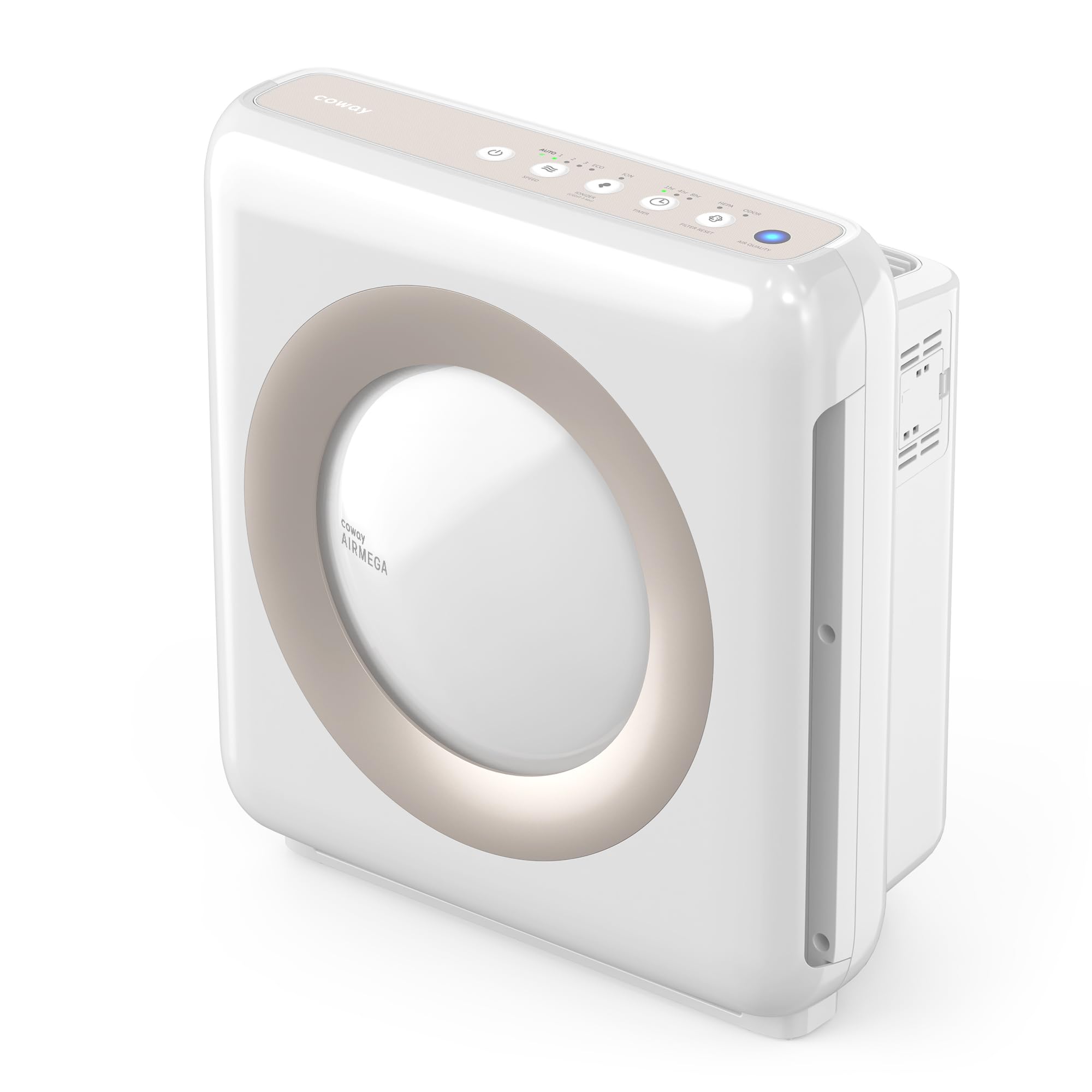
Coway Airmega AP-1512HH "Mighty" — True HEPA, Proven Over Years
The Mighty's filter is True HEPA, rated at 99.97% at 0.3 micron, which matches the US definition exactly. AHAM rates it for 361 sq ft, with a CADR of 233 for smoke, 246 for dust and 240 for pollen.
It's been one of the best-selling purifiers in the US for years (4.6 stars across about 29,000 reviews), so there's a long track record behind it. It adds a washable pre-filter, a carbon deodorization filter and an ionizer that you can switch off. There's also a filter indicator, so you know when replacement is due, and a 3-year warranty. It usually costs about $230, often less on sale.
Levoit Core 400S-P — Smart Sensor, AHAM-Verified CADR
Levoit describes the Core 400S-P's main filter as "HEPA-grade", not True HEPA. Going by the section above, that's a reason to check the independent numbers, and here they're good. AHAM Verifide CADR is 231 for smoke, 240 for dust and 259 for pollen. The pollen figure is the best of the three picks.
It pairs the 3-in-1 filter (pre-filter, main filter, activated carbon) with a laser PM2.5 sensor. The sensor shows you what the air is doing in real time and drives the auto mode, so the fan responds to particle spikes in your home instead of running at a fixed speed all day. It works with the VeSync app, Alexa and Google, and costs about $190.
Filter Replacement: The Hidden Cost
Genuine branded replacement filters cost more than generic ones. The branded filter is built to the spec the purifier was tested with, and it keeps that performance through its rated life. Third-party replacements are hard to verify and may not meet the grade printed on the box.
If you've paid for a branded purifier, it's worth paying for the branded filters too.
Most manufacturers recommend replacing the main filter every six to twelve months, depending on how much you run it and how dirty your air is. The Levoit Core 300, for comparison, is rated for 6-8 months. Use the filter indicator if your unit has one, but also look at the filter: if it's gray and clogged early, change it early.
See our related guides: allergy air purifiers, air purifiers for asthma, and how air purifiers work. Or see the main air purifier roundup for full product recommendations.