The best vitamin for tiredness is the one you're actually low in, and for most people that's vitamin D, B12 or iron. Our top pick is Nature Made D3 2000 IU, about $16 for 250 softgels. The best-value B12 is Nature Made B12 1000 mcg, about $11 for 160 tablets. Take iron only after a blood test.
A few vitamins have solid evidence behind them for fatigue, but only in people who are actually low in them. Most of what gets sold as an "energy booster" doesn't. This guide covers who tends to need what, which products on Amazon are good value, and what you can skip. If you haven't worked out why you're tired yet, start with why you're always tired.
This is general information, not medical advice. Two things before you buy anything. First, if you've been tired for weeks and can't explain it, see your doctor. A basic blood panel (complete blood count, ferritin, B12, vitamin D and a thyroid test) answers most of the questions this article can only guess at. Second, supplements aren't approved by the FDA before they go on sale. Manufacturers are responsible for what's in the bottle, which is why we've leaned toward products that carry a USP Verified or NSF mark on the listing. Check with your doctor or pharmacist before starting anything, especially if you take prescription medication or are pregnant.
The iron, B12 or vitamin D guide goes deeper on telling the three apart. And if poor sleep could be the real cause, read why you're still tired after 8 hours of sleep first.
Vitamin D: the most common gap
Your skin makes vitamin D from sunlight, and in winter that mostly stops for anyone living in the northern half of the US. People who work indoors, have darker skin, are older, or cover most of their skin outdoors are more likely to run low. Low vitamin D is linked to fatigue, muscle weakness and low mood, though the symptoms are vague enough that plenty of people live with it for years without connecting the dots.
The NIH Office of Dietary Supplements (ODS) puts the recommended intake at 600 IU (15 mcg) a day for adults up to 70 and 800 IU over 70. The upper limit for adults is 4,000 IU (100 mcg) a day from all sources combined. Higher doses to correct a confirmed deficiency should come from your doctor, with follow-up testing.
Best vitamin D: Nature Made Vitamin D3 2000 IU
The Nature Made D3 2000 IU softgels are about $16 for 250 softgels, so roughly six cents a day. They carry 4.8 stars from around 40,000 reviews and the USP Verified mark, which means an independent lab has checked that the softgels contain what the label says. Each one is 2,000 IU (50 mcg) of D3, the form the listing (and most researchers) prefer over D2.
2,000 IU is half the adult upper limit. That leaves headroom, but if you also take a multivitamin or a calcium supplement with vitamin D in it, add those numbers together.
If you'd rather stay closer to the recommended intake, the Thorne Vitamin D-1,000 is a 1,000 IU capsule from a brand that third-party certifies its products. It costs about $17 for 90.
Vitamin D is fat-soluble, so take it with a meal that has some fat in it.
Vitamin B12: the one vegans can't skip
B12 deficiency causes fatigue and weakness that look a lot like iron deficiency. It can also cause tingling or numbness in the hands and feet, balance problems and mood changes. Those nerve symptoms are the reason not to self-treat this one quietly. Long-term deficiency can cause nerve damage, so if you have tingling plus tiredness, get tested.
People most at risk: vegans and vegetarians (B12 is found almost only in animal foods), adults over 50 (who absorb B12 from food less well), people taking metformin or long-term acid-reducing medication, and anyone who has had weight-loss surgery or has a gut condition that affects absorption.
The NIH ODS lists no upper limit for B12, because no harm has been found from high intakes from food and supplements.
Best value: Nature Made Vitamin B12 1000 mcg
Nature Made B12 1000 mcg costs about $11 for 160 time-release tablets. It has 4.7 stars from roughly 35,000 reviews. It uses cyanocobalamin, the standard form, which works fine for most people. The listing's own wording is careful here: B12 "helps reduce fatigue for those low in vitamin B-12." That qualifier is honest, and it applies to every B12 product on the market.
Best for vegans: Jarrow Formulas Methyl B-12 1000 mcg
Jarrow's Methyl B-12 is a lemon-flavored chewable using methylcobalamin. The listing says it's vegan and free of the major allergens. About $12 for 100, with 4.7 stars from around 5,400 reviews. Jarrow cites research suggesting methylcobalamin is better retained than cyanocobalamin. That's the manufacturer's claim, and for most people either form does the job. Buy this one if you want a vegan-labeled chewable.
Iron: only with a blood test
Iron deficiency is a common cause of fatigue, particularly in women with heavy periods, people who are pregnant, vegans and vegetarians, frequent blood donors and endurance athletes. But iron is different from vitamin D and B12 in one important way. Your body has no good way to get rid of extra iron, so it builds up. Taking iron when your levels are already normal can do harm over time, and some people have a genetic condition (hemochromatosis) that makes them store too much iron already.
So don't take an iron supplement on a hunch. Ask your doctor for a ferritin test (your iron stores) and a complete blood count. If they confirm you're low, they'll tell you what dose to take and for how long. Low iron also needs a cause: in men and post-menopausal women especially, doctors will want to know why.
The NIH ODS upper limit for iron is 45 mg of elemental iron a day for adults. Doctors often prescribe more than that for a short time to treat diagnosed anemia, which is exactly why it should be their call.
Keep iron supplements locked away from children. Accidental overdose of iron-containing products is a leading cause of fatal poisoning in children under 6. That warning is on every iron bottle sold in the US for a reason.
Best iron (once you know you need it): Thorne Iron Bisglycinate
Thorne Iron Bisglycinate gives you 25 mg of elemental iron per capsule as iron bisglycinate chelate. That form is often easier on the stomach than ferrous sulfate, which is notorious for constipation and cramps. It's NSF Certified for Sport, so it's been tested to match its label. About $16 for 60 capsules, 4.7 stars from roughly 9,000 reviews.
Your doctor may instead recommend a standard 65 mg ferrous sulfate tablet. We cover that option in the iron, B12 or vitamin D guide.
Iron absorbs better with vitamin C and worse with calcium, so keep it away from dairy, calcium supplements and antacids by a couple of hours. Iron can also interfere with some medications, including thyroid medication, so ask your pharmacist about timing.
Multivitamins: a baseline, not a fix
If you aren't deficient in anything specific but want some nutritional insurance, a multivitamin is a reasonable choice. Just know what it isn't. Multivitamin doses are set for maintenance, so they won't correct an established deficiency.
The Nature Made Multivitamin For Her has 23 nutrients, including iron, folic acid, vitamin D3 and calcium. It's USP Verified and costs about $20 for 90 tablets. Because it contains iron, it suits women who still have periods. Women past menopause usually don't need extra iron, and Nature Made sells a 50+ version without it.
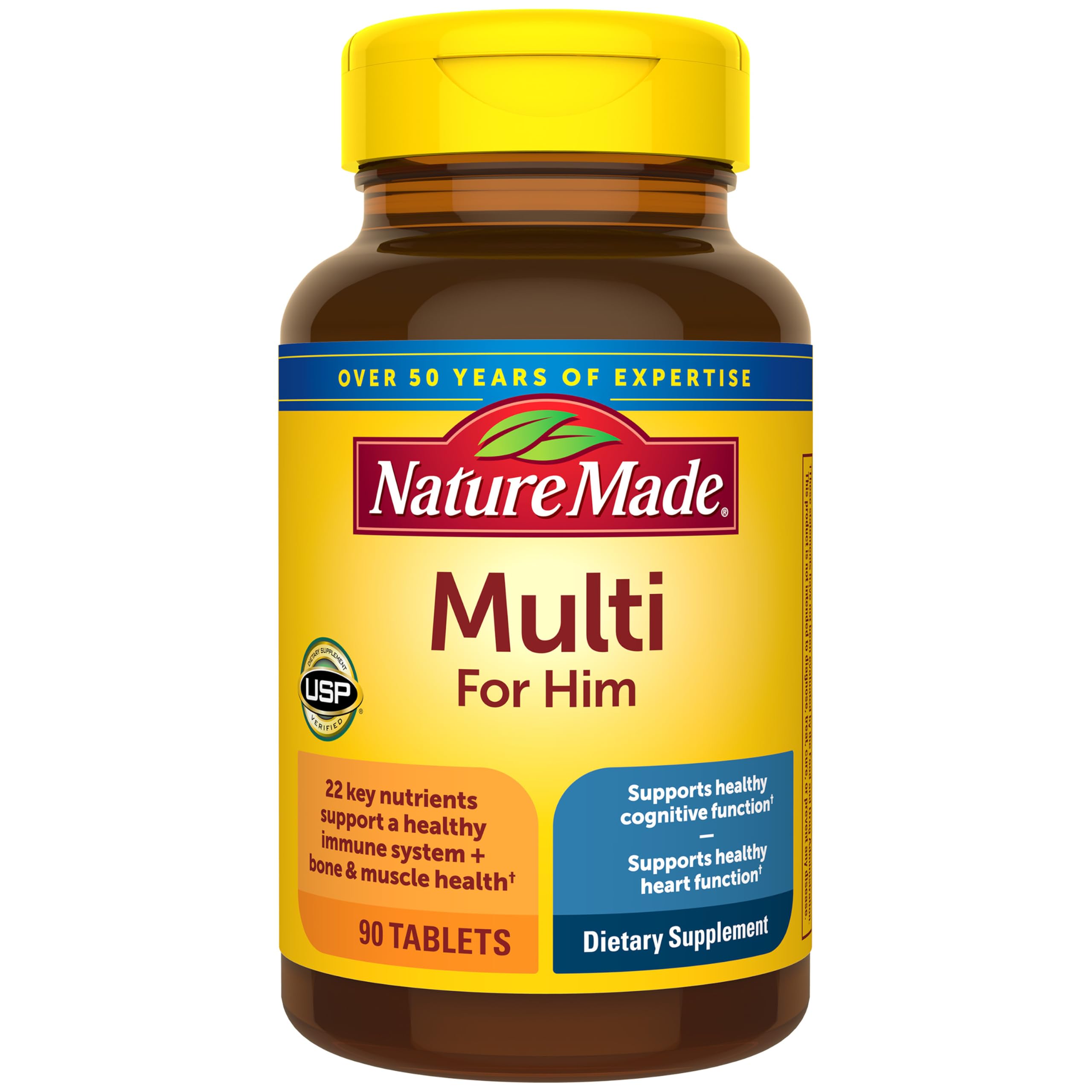
The Nature Made Multivitamin for Him has 22 nutrients and no iron, which is the right call for most men. USP Verified, about $10 for 90 tablets, 4.7 stars from around 16,600 reviews.
If you take a multivitamin alongside a separate vitamin D or iron product, add up the totals so you stay under the upper limits.
What's not worth buying for tiredness
Stimulant "energy" supplements. Products built around caffeine, guarana or other stimulants cover up fatigue without fixing the cause. Stop taking them and you're back where you started, sometimes worse.
High-dose B-complex when you're not low. Extra B vitamins are mostly excreted. There's no good evidence that megadoses raise energy in people who aren't deficient. The bright yellow urine is the riboflavin leaving.
Adaptogens sold as energy fixes. Ashwagandha has some evidence for stress and sleep, but as a direct treatment for tiredness it's weak, and it isn't suitable for everyone (pregnant people and those with thyroid conditions should ask a doctor first). If you're tired, finding the cause comes first.
Quick-reference table
| Nutrient | More likely to be low if you're... | Common signs | Our pick |
|---|---|---|---|
| Vitamin D | Indoors a lot, darker-skinned, older, in a northern state in winter | Fatigue, muscle weakness, low mood | Nature Made D3 2000 IU |
| B12 | Vegan, over 50, on metformin or acid reducers | Fatigue, tingling, numbness, brain fog | Nature Made B12 or Jarrow Methyl B-12 |
| Iron | A woman with heavy periods, pregnant, vegan, a frequent blood donor | Fatigue, pale skin, breathlessness | Thorne Iron Bisglycinate, only after testing |
| General baseline | Eating poorly or unsure | Non-specific tiredness | Nature Made Multi for Her / for Him |
For a closer look at which deficiency fits your symptoms, see iron, B12 or vitamin D: how to choose. For habits that help alongside any supplement, the morning routine for energy guide covers light, water and caffeine timing.
When are these supplements cheapest? 3 years of Amazon prices
We tracked daily Amazon prices for 12 energy and fatigue products, including all seven supplements above, from October 2023 to October 2026. The typical one was 10% or more below its usual price (its 90-day median) on 8.6% of days. November was the cheapest month, about 6% under the 3-year median, and June the dearest.
Over Black Friday-Cyber Monday, 38% of products were cut by 10% or more, by a median 20%. Prime Day reached 9%, and October's deal days produced no 10% cuts.
Look at Thorne. Its Iron Bisglycinate and Vitamin D were on sale on less than 1% of days, yet both were cut 20% over Black Friday-Cyber Monday 2024 (the iron hit $11.20 on November 28). Nature Made D3 2000 IU was cut 33.1% on Prime Day 2025.
Subscribe & Save, coupons and Prime-member deals aren't captured, only the public price. Method: our Amazon price study.
Frequently asked questions
What's the best vitamin for tiredness? It depends on what you're low in, which is why a blood test is worth more than any product recommendation. Vitamin D is the most common shortfall for people who don't get much sun. B12 matters most for vegans and older adults. Iron matters most for women with heavy periods, but only after a test confirms it.
Can vitamins really help with tiredness? Yes, when a deficiency is causing it. If your vitamin D, iron and B12 are all normal, more won't give you extra energy. Vitamins correct shortfalls; they don't work like caffeine.
Is it worth getting a blood test before buying supplements? For iron, always, because too much iron is harmful. For ongoing tiredness in general, also yes. Your doctor can check ferritin, B12, vitamin D and thyroid function in one blood draw, and a thyroid problem or anemia won't be fixed by a supplement you picked off a shelf.
How long do vitamins take to work for tiredness? If you were deficient, many people notice a difference within a few weeks, though rebuilding iron stores takes months. Your doctor will usually retest to check progress. If nothing changes after a couple of months, the deficiency probably wasn't the whole story.
Are supplements FDA-approved? No. The FDA doesn't approve dietary supplements before they're sold. Look for a USP Verified or NSF mark if you want independent confirmation that the label matches the contents.
Sources
- NIH Office of Dietary Supplements. Vitamin D: Fact Sheet for Health Professionals.
- NIH Office of Dietary Supplements. Vitamin B12: Fact Sheet for Health Professionals.
- NIH Office of Dietary Supplements. Iron: Fact Sheet for Health Professionals.
- US Food and Drug Administration. Information for Consumers on Using Dietary Supplements.