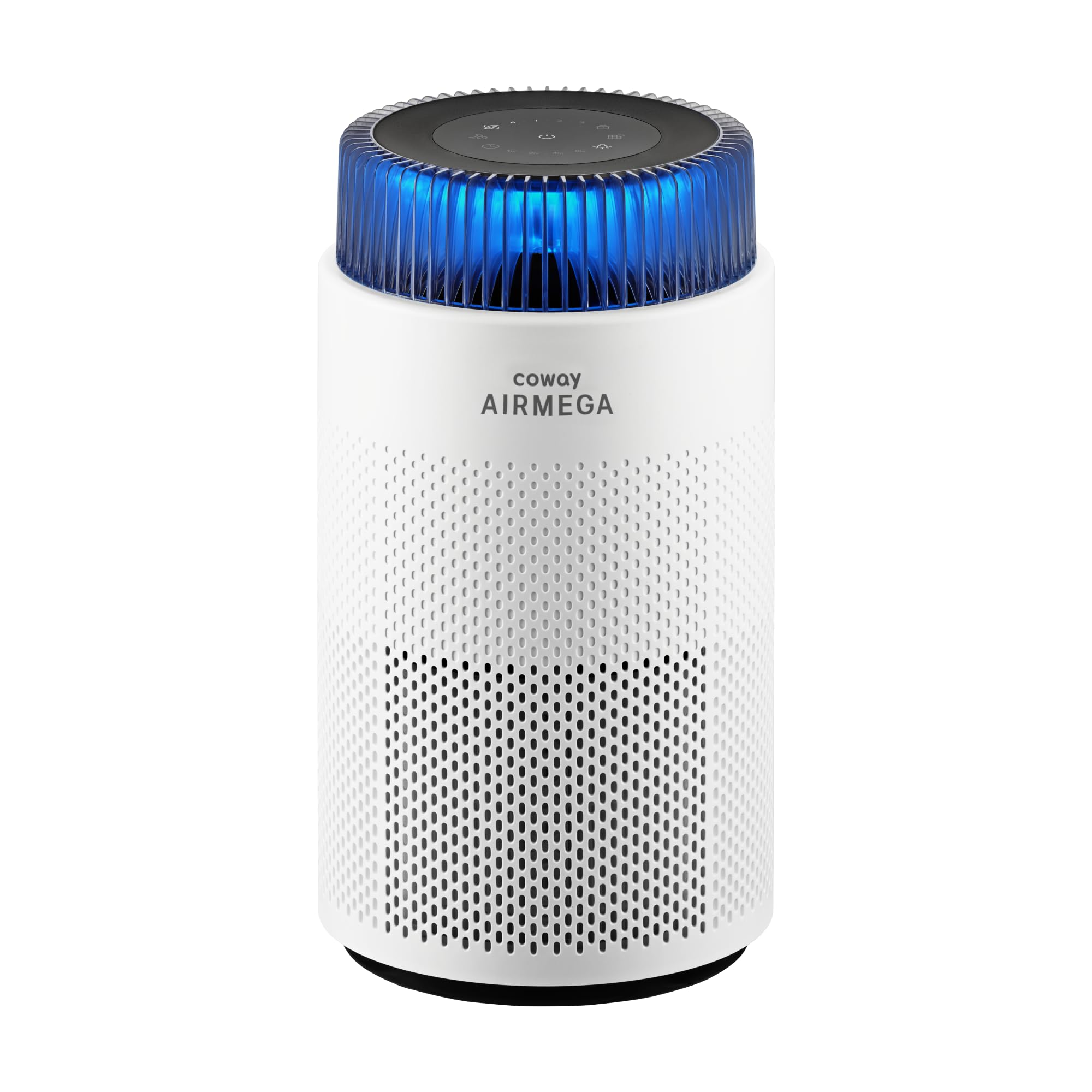
The best nursery air purifier here is the Coway Airmega 100: mechanical HEPA with no ionizer, a 20dB sleep mode that turns the lights off, and plenty of CADR for a typical nursery. On a budget, the Levoit Core 300-P (about $81) is also ionizer-free and runs at 24dB in sleep mode.
This is general information, not medical advice; talk to your pediatrician about anything specific to your baby's breathing or allergies.
Babies breathe faster than adults (around 30-60 breaths per minute versus 12-20), which means they take in more air, and more of whatever is in it, per pound of body weight. The case for clean air in a nursery is reasonable on that basis alone, and stronger if there are allergies or respiratory conditions in the family, pets in the home, or a busy road nearby.
The requirements for a nursery purifier are different from a general-purpose pick. Noise matters more, because a sleeping baby is easy to wake. Safety matters more: ionizers that produce trace ozone don't belong in a small closed room where a newborn spends 14-16 hours a day. And design matters, since a unit with sharp edges, small removable parts, or a filter door a crawling toddler can open isn't suitable.
What to Avoid in a Nursery Purifier
Ionizers that can't be turned off. Ionization can produce trace ozone, and the EPA notes that even relatively low amounts of inhaled ozone can irritate the lungs. Even at the low levels from reputable brands, it makes sense to avoid it in a small, closed room where a newborn is sleeping. Choose a purifier with no ionizer, or one where it can be switched off.
High-noise models. Anything above 30dB on its lowest setting can interrupt sleep. Anything above 40dB is clearly audible. That rules out some otherwise good purifiers: the Medify MA-40, for example, is rated at 46dB even on its lowest speed.
Units with easy-open filter compartments. Once a child is mobile, they'll investigate anything at floor level. A purifier with a filter door that clicks or pulls open is a problem in a room with an exploring toddler.
"HEPA-type" or ungraded HEPA claims. A nursery isn't the place for cut-price filtration. True HEPA (which the EPA describes as capturing at least 99.97% of particles at 0.3 microns), or a model listed in the AHAM Verifide directory, at minimum.
The Best Nursery Air Purifiers
I've gone through the specs, noise ratings and buyer reviews to narrow it down to three.
1. Coway Airmega 100 -- Best Overall for Nurseries
The Airmega 100 is rated at 20-48dB, and 20dB is the quietest floor of any purifier we track. Its sleep mode turns the lights off and drops the fan to its lowest speed, which is exactly what you want once the baby is down.
Filtration is mechanical: a pre-filter, a deodorization filter and a HEPA filter. There's no ionizer in the stack, so there's nothing to remember to switch off. CADR is 108 CFM for smoke, 124 for dust and 112 for pollen, and Coway says it cleans a 405 sq ft space in 30 minutes. A typical nursery is a fraction of that, so it gets a lot of air changes even on low.
The AQI light is useful in a nursery. It gives a quick read on whether particle levels are up, which might prompt you to bump the fan speed before bedtime. There's also a night light, a timer, a filter indicator and a 2-year warranty. No app.
Specs
- Noise: 20-48dB
- CADR: smoke 108, dust 124, pollen 112 CFM
- Lights: off in sleep mode; optional night light
- Ionizer: none
- Approx. price: about $117
2. Levoit Core 300-P -- Best Budget Nursery Pick
The Core 300-P has no ionizer either. It's purely mechanical filtration, and it's AHAM, ETL and CARB compliant. You can check any model against CARB's list of certified air cleaners, which covers ozone emissions. For parents who want the simplest possible setup, this is it.
It runs at 24dB in sleep mode, and the display can be switched off completely. The body is compact and stable. AHAM Verifide CADR is 143 CFM for smoke, 153 for dust and 167 for pollen; Levoit says it gives a 222 sq ft room 4.8 air changes an hour, so a small nursery gets well beyond that.
There's no sensor or app, just manual speeds and a 2/4/6/8-hour timer. Levoit says to replace the filter every 6-8 months. At about $81, with around 109,000 reviews at 4.7 stars, it's hard to argue with.
Specs
- CADR (AHAM Verifide): smoke 143, dust 153, pollen 167 CFM
- Coverage: 222 sq ft at 4.8 air changes/hour
- Noise: 24dB (sleep mode)
- Ionizer: none
- Approx. price: about $81
3. Blueair Blue Pure 211i Max -- Best for a Large Shared Bedroom
This one needs a caveat up front. The 211i Max is a large-room purifier, rated for 674 sq ft in 12.5 minutes with a CADR of about 410 CFM. In a small nursery it's overkill, and at about $280 it costs close to three times as much as the Airmega 100.
Where it fits is room-sharing. If the crib is in a large primary bedroom, a small purifier has to run on a louder speed to keep up. The 211i Max can stay at its 23dB low setting and still move plenty of air.
The other thing to know: Blueair's HEPASilent filtration is mechanical plus electrostatic, meaning it charges particles so the filter catches them more easily. Blueair says it removes 99.97% of particles, and the unit is AHAM Verified. If you want purely mechanical filtration with no charging stage at all, the Airmega 100 or Core 300-P is the simpler choice. It has a washable fabric pre-filter, 360-degree intake, an air quality sensor, auto mode and the Blueair app.
Specs
- CADR: about 410 CFM (Blueair)
- Coverage: 674 sq ft in 12.5 minutes
- Noise: 23dB (low), 53dB (high)
- Filter: HEPASilent (mechanical + electrostatic) + washable pre-filter
- Approx. price: about $280
Placement in a Nursery
Put the purifier on the floor, at least a couple of feet from the crib. Avoid placing it right next to the baby's head; even a quiet fan is more noticeable up close than from across the room. A corner or a spot along a wall works well, so air circulates around the room rather than blowing straight at the crib.
Keep the purifier out of reach once the child starts pulling up on furniture, typically around 6-9 months. Some parents move it to a shelf or dresser top at that stage.
Run it continuously while the baby is in the room. Running it only now and then doesn't do much; the particle reduction builds up over continuous operation.
See the full air purifier roundup for all options, or our quiet air purifiers guide for more on low-noise picks.
Sources
- US EPA: Ozone generators that are sold as air cleaners
- US EPA: What is a HEPA filter?
- AHAM Verifide: Directory of certified air cleaners
- California Air Resources Board: List of CARB-certified air cleaning devices