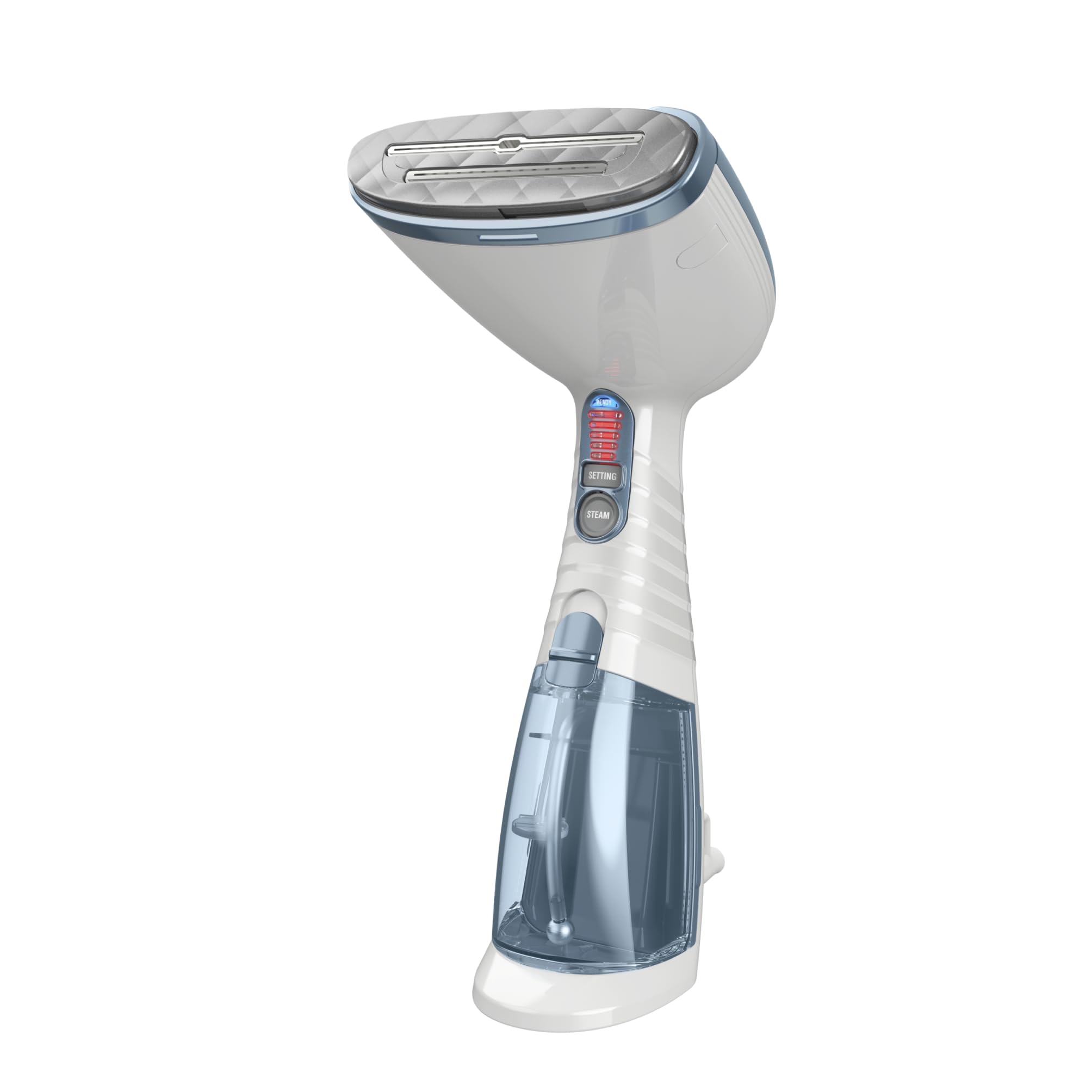
A clothes steamer is a small appliance that boils water and pushes steam into hanging fabric, so wrinkles relax and drop out without an ironing board. Handheld models (about $25 to $75) suit quick touch-ups and travel. Upright floor models suit curtains and bigger batches. A steam iron is still the tool for sharp creases.
There's no pressing, and you don't wait for a soleplate to heat up. You hang the garment on a door, point the steamer at it, and the creases drop out under the weight of the fabric. That's the sales pitch, and it's mostly true. But a steamer is great at some jobs and useless at others, and the marketing rarely says which.
This guide covers how steamers work, how the three main options compare, what they're good and bad at, which fabrics are safe, and whether one is worth the money. If you already know you want a handheld and just need a model, go straight to our best handheld clothes steamer picks.
How a clothes steamer actually works
Inside the unit is a small water tank and a heating element. The element boils the water and pushes steam out through a nozzle or plate at the front. You hold this close to (or lightly against) the fabric, and the steam loosens the fibers that are holding the creases.
There's no mechanical pressing. That's the basic difference between a steamer and an iron. An iron uses heat, moisture and pressure together. A steamer uses heat and moisture only. The wrinkles release because the fibers relax and the garment's own weight pulls them smooth.
So a steamer works best on hanging fabric, where gravity does half the job. Lay a shirt flat on a table and try to steam it and you'll mostly end up with damp fabric and the same wrinkles.
Most handheld steamers are ready in 15 to 40 seconds. Tanks run from about 2 oz on compact travel models to 7 or 8 oz on full-size handhelds, which gives anywhere from a couple of minutes to around 20 minutes of steam.
Handheld vs upright steamer vs steam iron
There are three common ways to get wrinkles out of clothes at home, and they suit different people.
A handheld steamer is the size of a large hair dryer or a travel kettle. It has its own small tank (about 2 to 8 oz), heats up in under a minute and plugs into any outlet. You hold it at the garment, so it's quick for one or two items and easy to store or pack. The small tank is the limit: you'll refill it often on a big job.
An upright steamer (also sold as a standing or garment steamer) sits on the floor. A large water reservoir in the base feeds steam up a hose to a wand, and most have a pole with a hanger built in. Because the reservoir is so much bigger, you can steam a closet's worth of shirts or a full set of curtains without stopping to refill. The trade-offs are the floor space it takes up and the fact that you can't take it on a trip.
A steam iron works differently. It presses a heated plate against the fabric on an ironing board, adding steam to help. That pressure is what gives you sharp trouser creases and flat, structured collars, which neither type of steamer can do. It's slower to set up and riskier on delicates.
| Handheld steamer | Upright steamer | Steam iron | |
|---|---|---|---|
| Size and storage | Small, fits a drawer or carry-on | Floor unit, needs closet space | Iron plus a board |
| Water capacity | Small (about 2-8 oz) | Large base reservoir | Small built-in tank |
| Best for | One or two garments, travel, delicates | Curtains, long dresses, batches | Dress shirts, creased trousers |
| Sharp creases | No | No | Yes |
| Typical Amazon price | About $25-$75 | Often more than a handheld | Varies widely |
Which type do you need?
Get a handheld if you steam a shirt or two before work, own a lot of delicates, travel, or live somewhere small. That covers most people. Our best handheld clothes steamer guide compares five current models from about $25 to $75.
Get an upright if you regularly steam curtains, long dresses, or several garments in one session, and you have somewhere to keep it. The bigger reservoir is the whole point.
Keep a steam iron if your week involves dress shirts with pressed collars or tailored trousers. Most households that buy a steamer keep the iron for those jobs. The steamer vs iron comparison goes through that choice in detail.
What a clothes steamer is good for
The obvious one is quick daily touch-ups: one shirt before work, or a blouse that came out of the dryer looking like a dish towel. It's ready in seconds and the job takes a few minutes, with no board to dig out of the closet.
Delicate fabrics are where it really earns its keep. Silk, chiffon and lightweight synthetics can scorch or go shiny under a hot iron. A steamer doesn't need to touch the fabric, so you're not gambling every time you pick up a nice blouse.
Then there are jobs an iron can't do. Curtains, while they're hanging. Sofa cushion covers. New curtains that arrived folded in a plastic bag look awful, and a steamer sorts them out in a few minutes without taking them down.
Travel is another good use. Compact models like the Rowenta Pure Pop weigh about 1.5 lb and fit in a carry-on. Hotel irons, when they exist, are hit and miss.
And there's freshening. A quick pass of steam over a wool sweater or blazer helps with light odors between cleanings, so you don't have to wash or dry-clean it after every wear.
What a clothes steamer cannot do
Sharp creases. A steamer will never give you a crisp line down a trouser leg or a knife-edge pleat. That takes pressing. If your job calls for formal trousers with visible creases, you need an iron.
Crisp shirt collars. A steamer relaxes the fabric, which is great for the body of a shirt, but a collar needs pressing flat against something hard to look structured. Steamed collars come out soft. Models with a heated plate, like the Conair Turbo ExtremeSteam, get you closer, but not all the way.
Heavy fabrics. Thick cotton, denim and heavy linen hold creases stubbornly. A steamer takes the worst out but rarely removes deep wrinkles completely. Several passes help, but at some point an iron is just quicker.
Large batches. A small tank runs dry fast, and even a 7 oz tank only lasts around 20 minutes. If you iron for a family, you'll be refilling constantly. An upright garment steamer with a big reservoir, or an iron, makes more sense for volume.
There's a fuller comparison of clothes steamers and irons if you want the side-by-side.
Which fabrics are safe to steam
Most fabrics are fine. Cotton, linen, wool, cashmere, polyester, nylon, acrylic, cotton velvet and polyester velvet all respond well with the right technique. Silk is safe if you steam from the inside of the garment and keep the head moving.
The ones to avoid:
Suede and leather. Steam can leave water marks and dry out the material. Use a suede brush instead.
Waxed cotton. Steam melts the wax coating, so keep waxed jackets and waxed canvas bags well away from it.
Vinyl, PVC and faux leather. These can warp, bubble or deform under heat.
Silk velvet and rayon velvet. Water marks these permanently. Cotton and polyester velvet are fine.
Fur, real or faux. Steam can mat or clump the fibers.
Anything with glued-on embellishments. Sequins, rhinestones and heat-transfer prints can come loose when the adhesive softens.
Anything labeled dry clean only, unless you know the fabric handles moisture.
When in doubt, test on an inside seam first. If the fabric marks or changes texture, stop. There's a fabric-by-fabric breakdown in the how to use a clothes steamer guide.
How to use one properly
The short version:
- Fill the tank with the water your manual recommends (distilled helps if your tap water is hard)
- Hang the garment. Don't steam it flat on a surface
- Switch on and wait for steady steam
- Pull the fabric taut with your free hand
- Start at the top and work down in slow, overlapping strokes
- Give each section a second or two of steam
- Let it hang for a minute before you wear it
The most common mistake is going too fast. People wave the steamer across the garment like they're painting a fence. Each section needs proper steam exposure. Slow down and the results improve straight away.
The second is not pulling the fabric taut. Without tension, the fabric sways away from the steam head and you end up chasing it. One hand steams, the other holds the garment.
The full step-by-step, including techniques for silk, wool and velvet, is in the how to use a handheld clothes steamer guide.
Hard water and steamers
Hard water is common in much of the US. It carries dissolved calcium and magnesium, and when you heat it inside a steamer those minerals form scale. Over time scale clogs the steam vents, the unit starts spitting water instead of steam, and eventually it gives up.
Check your manual before you pick a water. Some makers are fine with tap water unless it's very hard, and some suggest mixing tap and distilled. If your water is hard, distilled water from the grocery store is cheap, and a gallon lasts weeks in a small tank.
Whatever water you use, descale every few weeks if you use the steamer often. Fill the tank with half white vinegar and half water (if your manual allows vinegar), run it until empty, then flush with a full tank of clean water.
What to look for when buying
The specs that matter are power, heat-up time, tank size and weight.
Power: US handheld steamers run from about 700W to 1875W on a standard 120V outlet. 700W handles light fabrics. For cotton shirts and heavier fabric, 1500W or more makes a real difference.
Heat-up time should be under about 45 seconds. Any slower and the convenience edge over an iron disappears.
Tank size is a trade-off. A 2-3 oz tank keeps a travel steamer light but covers a garment or two. A 6-8 oz tank gives 10-20 minutes of steam but adds weight in your hand. A removable tank is much easier to fill.
Weight matters because you hold the thing at shoulder height. Lighter is better, especially for curtains.
Steam output in grams per minute is the most useful performance figure, but US listings rarely give it. When they don't, compare wattage and minutes of steam per tank.
What matters less: lots of steam modes (you'll use one or two) and long accessory lists (a brush and a crease tool are the ones that get used).
Read the one-star reviews before you buy. If several people mention dripping or spitting, that model has a problem. Spitting hot water is also a safety issue. In 2024 the US Consumer Product Safety Commission announced a recall of about 2 million Vornado-made handheld steamers sold under the Steamfast, Vornado and Sharper Image names, because they could expel hot water from the nozzle. The same year it expanded a recall of Black+Decker garment steamers to about 2 million units for the same hot-water problem.
The best handheld clothes steamer guide compares five current models.
How much to spend
Most good handheld steamers on Amazon cost $25 to $75.
At around $25, the HiLIFE 700W is the cheapest option with a big track record: more than 131,000 ratings at 4.2 stars. It's fine for light fabrics and slower on heavy cotton.
From about $45 to $75 you get more power, a heated plate, or a compact travel design from brands like Conair and Rowenta. The Conair Turbo ExtremeSteam, for reference, is about $67 for 1875W, a 35-second heat-up and up to 20 minutes of steam from a 7.3 oz tank.
Below $25, from brands with only a handful of reviews, you're gambling on weak steam and drips.
Is a clothes steamer worth buying?
For most people, yes. If you wear casual or smart-casual clothes and avoid ironing because the board is a hassle, a steamer does the job faster. The same goes if you own a lot of delicates or travel often.
It falls short if your wardrobe is mostly formal. Crisp collars, sharp trouser creases and structured shirts are iron territory. If that's your morning routine, keep the iron and skip this.
Most people who buy a steamer keep the iron too. The steamer handles most of the week, and the iron comes out for the formal stuff.
FAQ
Can a clothes steamer replace an iron?
For most daily jobs, yes. For formal shirts with crisp collars and trousers with sharp creases, no. Most people end up owning both.
Does steaming clothes remove wrinkles as well as ironing?
It removes wrinkles but doesn't press them. The result is smooth rather than crisp. That's fine for casual wear. Formal wear needs an iron.
What water should I use in a clothes steamer?
Whatever your manual recommends. Some makers say tap water is fine unless it's very hard, and some suggest a tap and distilled mix. If your water is hard, distilled water cuts down on scale.
How long does a clothes steamer take to heat up?
Most handheld models are ready in 15 to 40 seconds.
Should I buy a handheld or an upright clothes steamer?
Buy a handheld if you steam one or two garments at a time, travel, or have little storage space. Buy an upright if you regularly do curtains, long dresses or several garments in one go, because the bigger tank means far fewer refills. Neither will press a sharp crease, so keep an iron for formal clothes.
Can you steam clothes while wearing them?
No. The steam is hot enough to burn you. When HSN recalled 5.4 million My Little Steamer units in 2021, the reports included second- and third-degree burns from hot water. Hang the garment and steam it off your body.
Why is my clothes steamer spitting water instead of steam?
Usually one of three things. You started before it fully heated, the tank is filled past the max line, or scale has built up inside. Scale is the most common cause if you have hard water, and the fix is a descale: half vinegar, half water, run it through, then flush with clean water (check that your manual allows vinegar).