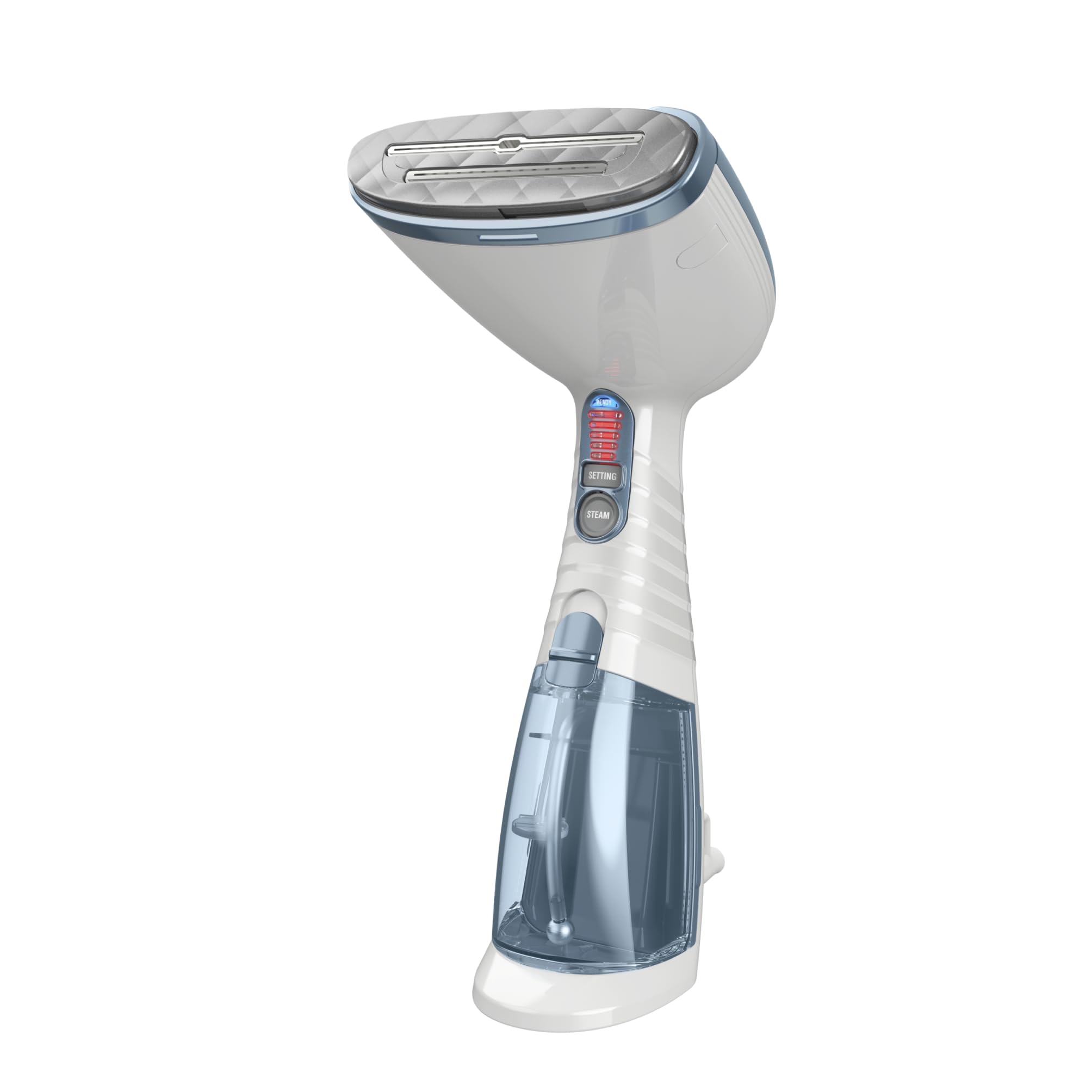
To use a handheld clothes steamer, fill the tank to the max line, hang the garment, and wait 15 to 40 seconds for steady steam. Pull the fabric taut and work from the top down in slow, overlapping strokes, giving each section a second or two. Let it hang a minute before wearing.
Learning the basics takes about five minutes. But there's a gap between using one and using one well. The wrong technique on the wrong fabric can leave water marks, leave the creases in, or occasionally damage the garment.
This guide covers first use through to maintenance, including the fabric-specific techniques most manuals skip. If you're still deciding whether a steamer is the right tool, read the steamer vs iron comparison first.
Before you start
Fill the tank with the right water
Handheld steamer tanks range from about 2 oz on compact travel models to 7 or 8 oz on full-size handhelds. Fill to the max line, not beyond.
Check the manual for what water to use. Some makers say tap water is fine unless it's very hard, and some suggest mixing tap and distilled. Hard water is common in much of the US, and its dissolved minerals form scale inside the steamer. Scale clogs the vents, makes the unit spit water instead of steam, and shortens its life. If your water is hard, a gallon of distilled water from the grocery store is cheap and lasts weeks.
Hang the garment
Steam works with gravity. Hang the garment on a hanger, a door hook or a shower rod, and pull the fabric taut with one hand while you steam with the other. The tension helps the steam get into the fibers, and the wrinkles drop out under the fabric's own weight.
Don't lay the garment flat on a bed or table. The steam has nowhere to go and the fabric just gets damp.
Wait for steady steam
Switch the steamer on and wait for a consistent, visible stream of steam. That takes about 15 to 40 seconds depending on the model (the Rowenta Pure Pop is around 15 seconds, the Conair Turbo ExtremeSteam about 35). Start too early and you get bursts of water instead of steam, which leaves wet patches.
How to use a handheld clothes steamer: basic technique
Step 1: Start from the top
Begin at the collar or shoulders and work down. Steam rises, so the lower sections get a little warm-up before you reach them.
Step 2: Hold the steamer head close
Hold the head about half an inch from the fabric, or in light contact with it. Some models are designed to touch the fabric, others to hover just off it. Check your manual. Light contact or near-contact usually works best.
Step 3: Pull the fabric taut
With your free hand, gently pull the bottom or side of the garment. That stretches the fibers slightly and lets the steam work. Without tension, the fabric just sways away from the head.
Step 4: Move slowly in downward strokes
Move the head slowly down in smooth, overlapping strokes. Each section needs a second or two of steam. Quick passes leave wrinkles behind.
Step 5: Let it hang
Leave the garment hanging for at least a minute before you wear it or put it away. The fabric needs to cool and dry. Put on a shirt while it's still damp and new wrinkles set almost immediately.
Technique by fabric type
Most casual clothes are fine with the basic technique. If you care about the result, adjust for the fabric.
Cotton (shirts, t-shirts, chinos)
Cotton responds well but heavier cotton may need several passes. Hold the steamer in direct contact and move slowly. For stubborn wrinkles in thick cotton, try steaming from the inside of the garment. A higher-wattage steamer helps here.
Linen
Linen wrinkles easily and is one of the harder fabrics to get smooth with steam alone. You won't get it perfectly flat without an iron. A steamer takes out the worst creases so it looks relaxed rather than slept-in.
Silk
Steam silk from the inside, or turn the garment inside out. Keep the head an inch or so away instead of making direct contact. Silk is heat-sensitive, and while steam is safer than an iron, holding it in one spot can leave marks. Keep moving.
Wool and cashmere
Wool responds very well to steam. The fibers relax easily and wrinkles drop out fast. Hold the head about an inch from the surface. Steam also refreshes wool between cleanings and helps with light odors, without the agitation of a washing machine that can cause pilling.
Synthetic fabrics (polyester, nylon, acrylic)
Most synthetics steam easily. Use light contact or hover just off the surface. Be careful with very thin synthetics, which can be more heat-sensitive than they look.
Velvet
Only steam cotton or polyester velvet. Never steam silk or rayon velvet, because water marks them permanently. For safe velvets, steam from the back of the fabric, never the face. Direct steam on the pile can flatten it.
Lace and embroidered fabrics
Turn inside out and steam from the back. Heat softens glue and moisture can mark delicate threads, so keep the head moving and don't hold it in one spot.
What you should never steam
Suede: steam leaves water marks and changes the texture of the nap. Use a suede brush.
Leather: real leather can spot and dry out. Faux leather can bubble or warp.
Waxed cotton: steam melts the wax coating. Keep waxed jackets and waxed canvas bags away from it.
Vinyl and PVC: can warp, bubble or deform.
Fur: real and faux fur can mat or clump.
Silk velvet and rayon velvet: water marks these permanently. Cotton and polyester velvet are fine.
Glued embellishments: sequins, rhinestones and transfers can come loose when the adhesive softens.
Dry clean only items, unless you know the fabric can handle moisture.
If you're weighing up a steamer or an iron for a particular fabric, the clothes steamer vs iron comparison goes into it.
Common clothes steamer mistakes to avoid
Steaming too fast
This is the big one. People wave the steamer across the garment like they're spray-painting a fence. Each section needs a second or two of steam. Slow down.
Not pulling the fabric taut
Without tension, the fabric pushes away from the head. Hold the hem or a side seam with your free hand and pull gently.
Overfilling the tank
Filling past the max line can make water leak from the vents or splash onto the fabric. Refill when empty instead.
Using the steamer before it's ready
Start before the element is fully hot and you get droplets instead of steam. Wait for the ready light and a steady flow.
Steaming stained fabric
Heat can set stains, especially protein stains like blood, sweat or food. Wash the garment first.
Ignoring the drip
If water drips from the head instead of vapor, the steamer isn't hot enough, is overfilled, or is tilted too far. Most handhelds work best upright or angled slightly forward.
Persistent spitting of hot water is also a safety problem. In 2024 the US Consumer Product Safety Commission announced a recall of about 2 million handheld steamers (Steamfast SF-425, SF-435, SF-440, SF-445 and SF-447, Vornado VS-410 and Sharper Image SI-428) because they could expel hot water from the nozzle. If you own one of these models, stop using it and check the recall. Black+Decker's HGS011 Easy Garment Steamer was recalled for the same problem, and that recall now offers a refund on every unit, including ones repaired under the earlier 2022 recall.
Using a steamer for more than clothes
Curtains
One of the best uses for a handheld steamer. You can de-wrinkle curtains while they're hanging. Start at the top and work down, pulling the fabric taut at the bottom. New curtains that arrived folded in a package respond especially well. A bigger tank helps here: a 7-8 oz tank lasts much longer than a 2 oz travel tank.
Bedding
Steaming pillowcases and a comforter cover while they're on the bed is quicker than ironing them. The result isn't as crisp, but the creases from washing come out.
Sofa cushion covers
Take the cover off and hang it if you can. If not, hold the steamer close and work in sections. It's a good way to refresh a fabric sofa between deep cleans.
Throws and other fabric
Throw blankets, table runners and fabric lampshades all respond to a quick steam. Steam can kill dust mites if it heats the fabric above about 130°F long enough, but you still need to vacuum afterward to pick up the mites and allergen debris.
How to maintain a handheld clothes steamer
Descale regularly
Mineral deposits build up over time, faster with hard water. If your manual allows it, fill the tank with equal parts white vinegar and water, run the steamer until the tank is empty, then run a full tank of clean water through to rinse.
Do this every few weeks if you use the steamer often, or monthly for occasional use. If steam output drops or it starts spitting, descale straight away.
Empty the tank after use
Don't leave water sitting in the tank. It encourages deposits and can go stale. Empty it, leave the cap off, and let it air dry.
Clean the steam head
Wipe the plate or head with a damp cloth once it's cool. Lint and fibers build up around the vents and cut output over time.
Store it upright
Store the steamer upright somewhere dry. Storing it on its side with water in the tank can cause leaks.
How long a tank lasts
It depends on the tank and the steamer. A compact model with a 2.3 oz tank, like the Rowenta Pure Pop, covers a garment or two. Full-size handhelds claim much longer: the Conair Turbo ExtremeSteam's 7.3 oz tank is rated for up to 20 minutes of continuous steam.
Refilling a removable tank takes a few seconds. If you plan to steam a big batch, you'll still be refilling often, and an iron or an upright steamer would be more efficient.
When a steamer isn't enough
A handheld steamer is great for quick touch-ups, delicates that can't take an iron, travel, curtains and upholstery, and refreshing clothes between washes.
It falls short on sharp trouser creases, crisp shirt collars, deep creases in heavy cotton or denim, and big ironing sessions where the tank makes it slow.
Most people end up owning both: the steamer for most of the week and the iron for formal clothes. If you're shopping for a model, the best handheld clothes steamer guide compares five on Amazon from about $25 to $75.
Quick reference card
| Step | What to do |
|---|---|
| 1 | Fill tank to the max line with the water your manual recommends |
| 2 | Hang garment on a hanger or door hook |
| 3 | Switch on, wait for steady steam (15-40 seconds) |
| 4 | Pull fabric taut with your free hand |
| 5 | Start at top, move slowly downward in overlapping strokes |
| 6 | 1-2 seconds per section, don't rush |
| 7 | Let garment hang for 1 minute before wearing |
| 8 | Empty tank after use, store upright |
FAQ
Do you need distilled water for a clothes steamer?
Not always. Follow your manual. Some makers say tap water is fine unless it's very hard, and some suggest a tap and distilled mix. If your water is hard, distilled water cuts down on scale.
Can you steam clothes while wearing them?
No. The steam is hot enough to burn you. Burn reports in the 2021 HSN steamer recall included second- and third-degree burns. Hang the garment and keep your free hand behind the fabric, out of the path of the steam.
How long does it take to steam a shirt?
About one to two minutes for a standard cotton shirt, depending on how wrinkled it is and how strong your steamer is. Add 15 to 40 seconds for heat-up.